
Stoicism Is No Easy Task
Life is brutal, and Stoicism begins exactly there.

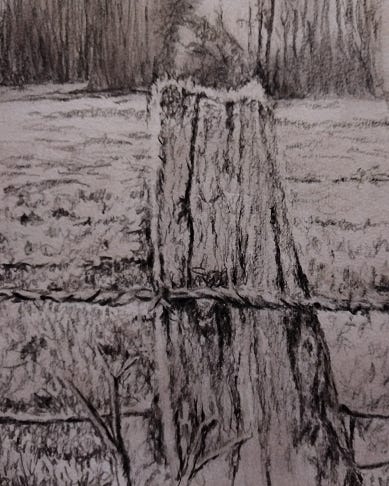
Picture drawn by Sue Doodlebee
Stoicism is not such an easy task. Life is often brutal. On paper Stoicism sounds so great, answering all the questions and giving us all the right answers. Warning us of our fear, our attachments to things we can not control, or warning us of our desires or aversions, like events or people. It sounds so simple. Until you start naming them. My son, my mother, my wife, the electric bill, food, my job, my neighbour’s attitude, the way they look at me at the shop, the clothes my kids wear, and so on. The responsibility that bears down on us. The feeling of failure, the feeling of being unseen. The feeling that no one knows your pain. Probably a deep loneliness that compels us either to fight an endless battle against life’s flow or find everything or anything to dull or distract from it all. But I guess for most it is a mix of both of these. Life also is no easy task.
I was inspired when I read Seneca. The door is open, virtue is open to the slave as well as the emperor, so there was a chance for me as well. Though even then I asked myself if that was even true. In a planet that has so much wealth and excess yet seems so unjust, where it is no exaggeration to say that so many fight for daily survival while being preached to by those that have it all. I hope that I have not made you feel too depressed. But we must see reality so that we are to understand our place in it. It is often skated over when we talk about Stoicism and it is unhelpful to do so. Reality is the starting place that we need to be at to live a philosophical life.
Stoicism offers no salvation, no “good life”, no 42. Stoicism simply provides you with a way to navigate life better and better as we progress to a stable existence whatever our circumstances. That is really what the Stoics meant by happiness, a stable existence that brings us calm and peace in what is good. Today we are bombarded by things to desire and the false hope of having them. We are told of liberty, and I know this is hard to hear, but social freedom, although just, will not make us happy. But it is often not what we call liberty that we seek. For we seek economic freedom to ease our desires, although they probably would not, or release us from the burdens or aversions that we have in each moment of our lives. But that is really the issue because even if we had that, there is no certainty it would remain.
As I have talked about many times, social, political, or environmental change at some point is inevitable. Stoicism does not tell us that we should go without or that we should suffer or struggle to survive. It only recognises that the events of life are unstable and to rely on what we have, or worse what we could have, is unstable and leaves our very happiness (stability or flow of life) to chance.
Stoicism also teaches us that we should take action towards outcomes that we prefer (and by prefer I mean actionable things that would be useful to our or society’s well-being, not misguided desire for the extra piece of chocolate). We might be poor so we search for ways to improve that situation. Or we might be sick so we again look for solutions that will help improve that. No one wants or needs to believe that it is okay to suffer or have to accept the social, political, or social circumstances that they live in.
Stoicism is a recognisability of reality. That our fate is not written, as we remain part of the causal chain that determines everything. But being only a part of that chain means we can not determine those outcomes. We can influence them to a lesser or greater degree, but they, with their many complicated parts, are outside our control and hence not up to us. When we focus on doing what is right, thinking and acting with correct reason, there we find a stability that is not found anywhere else. You would have heard the expression of your inner citadel and that is exactly what we mean. We define our happiness by who we are and what we do. Not by what we achieve or how much we have or how people view us, or even how much pain we suffer.
But Stoicism is not just a set of ideas or a matter of reframing your thoughts. It is a way of living that changes you when you practise in noticeable ways. Moreover it affects those around you in ways that are often unexpected.
For 20 years this year I have been a progresser in practise and I know my life is better for it. I do not think that I have taken but a few steps towards virtue yet much is different for me than it was before.
I remember one instance maybe 15 years ago. I was tired, feeling unwell and under stress. I had been called several times to the dinner table while I was trying to do something else. Irritated by the persistence my attitude had already begun to degrade. The meal had been diligently prepared and everyone else sat around the table in good spirits and waiting eagerly for me to appear to get stuck in. Everyone else had a spoon and fork, but I had been given a knife as for some reason I used to always insist that I had to have all three, and without complaint this had been done for me. Yet the knife had a round end and not a pointed end and everyone knew that I did not like that. I complained and my son told me “I’m not getting it”. Flabbergasted and lost for words I retreated from the table without eating and leaving the rest of the family with words to express my discontent that could not be mistaken for anything else and returned to what I was doing before. My mind filled with every justification and impression, all of which I assented to and by doing so fully recognised that it was everyone else at fault despite the fact that I did not even need a knife for the meal that I was about, or should have, eaten.
Nothing in that moment was guided by reason. There was no logic in my irritation. No evaluation of what was actually happening. I built an entire chain of impressions. Each one accepted without examination. They solidified into certainty that I was right. From that false conviction every later action followed. The small annoyance became a judgement. The judgement then became a grievance. The grievance in turn became a story about being wronged. A story shaped my behaviour towards the people around me. By the time I reached the end of this chain I had created the suffering I claimed was being imposed on me.
This is the point that we Stoics insist upon. The event itself was trivial in this instance. The knife, the table, the calls to dinner held no power of their own. The only cause was my assent to the first unexamined impression. Once I admitted that in, everything that followed was an unsurprising sequence. Stoicism does not remove the knife, the tiredness, or the stress. It gives you the ability to stop at that first impression before it becomes a judgement. If I had paused and asked myself what the fact actually where. Had I judged only what was up to me none this would have occurred. The situation would have remained a small irritation instead of a chain of errors that harmed me and others.
What Stoicism gives us is the ability to break that chain. The world will not become easier or fairer. But our first impression can be examined before they governs us. That is the practice of Stoicism. An impression arrives. We pause. We ask does this align with virtue. Only then do we choose whether to assent. Nothing complex. Just the refusal to let the first movement of the mind become a judgement without being examined. That small discipline turns instability into something we can live with. And maybe a more stable happier flow of live.
It is why Stoicism works. The world is unstable but our judgements do not have to be. Circumstances change, fortunes go up and down, people behave as they do and events unfold according to causes most far beyond our reach. But the one point in that whole causal chain where we stand is the point where reason can be applied. By aligning our decisions with what is actually up to us, we gain a stability that is not dependent on outcomes, conditions, or the behaviour of others.
This is the starting point of Stoic practice. Not escaping life or denying hardship or pretending we do not feel the pull of desire or irritation. It is our recognition that these impressions will always be there. Not forgetting that judgement remains ours. The next time the knife is wrong, , the bill arrives, the neighbour looks at you, or the day collapses in on itself you will still feel the first movements. But you do not have to let it become the story that drags you into that suffering. You can meet it, examine it, and choose.
That is the freedom that Stoicism provides. Not freedom that unburdens us from the life’s hardship, but freedom in it that never can be taken away.
My book Kristy’s Garden Tales has become a tool for both adults and children. For children to form their first moral impressions and adults to see Stoic ideas come to life again through the clear view of narrative and imagination.
It would be of great service to me if you would buy a copy and I hope it will be of service to you if you do. Even if you do not have children you can read it and pass it on. They link provided here is for Amazon.com but it is also available on most Amazon regions and in French under the title Contes du Jardin de Kristy.

Please note by buying my book from any of the links I have provided as an Amazon Associate, I earn extra from qualifying purchases with no additional cost to you
"a progresser in practise" I like this turn of phrase. Sometimes I think of myself as a "Stoic learner."
Very well said Edgar!